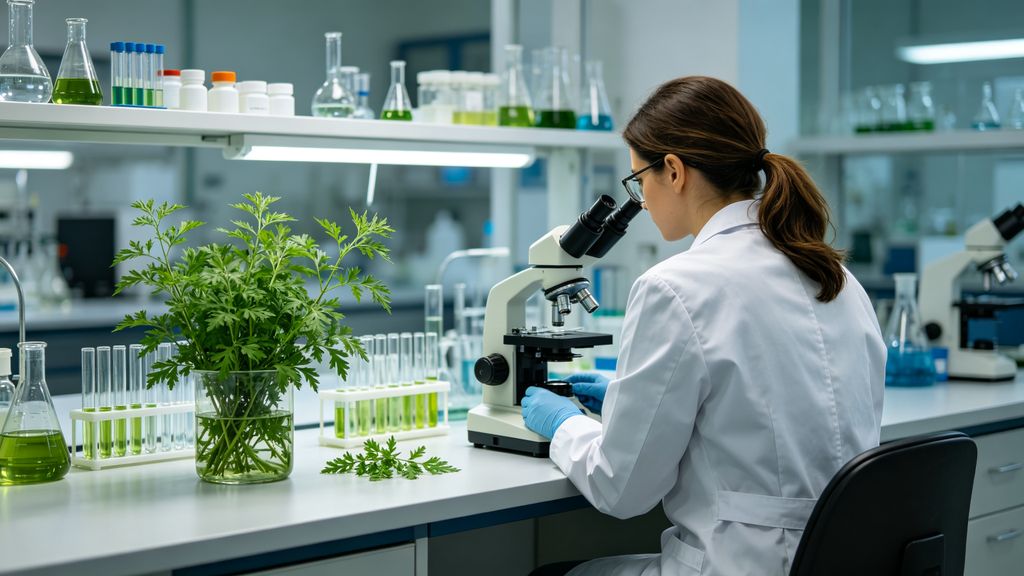
Tu Youyou (b. 1930), from Ningbo, Zhejiang, is chief scientist at the China Academy of Chinese Medical Sciences. In 2015 she won the Nobel Prize in Physiology or Medicine for discovering artemisinin, a malaria drug - the first mainland Chinese scientist to win a Nobel science prize.
The story began in 1969, when malaria raged across Southeast Asia and Tu was tasked with finding a treatment. In the Handbook of Prescriptions for Emergencies (by the Eastern Jin physician Ge Hong) she read: "Take a handful of qinghao, soak in two sheng of water, wring out the juice, and drink it all."
The breakthrough: she found that low-temperature ether extraction preserved artemisinin's active compound, and in 1972 she succeeded. Fast-acting and mild in side effects, the drug has saved millions of lives worldwide.
During "Project 523", Tu's team even tested the drug on themselves to confirm safety. Artemisinin remains a WHO-recommended first-line malaria treatment.
After the award she said: "Traditional Chinese medicine is a great treasure-house; we must work to mine it." Her story shows that ancient wisdom plus modern science can work miracles.
Tu Youyou (1930- ) is the first Chinese scientist to win a Nobel Prize. In 2015 she won the Nobel Prize in Physiology or Medicine for discovering artemisinin.
Artemisinin is the specific drug against malaria, an ancient disease killing hundreds of thousands yearly; in Africa it is among the greatest killers of children.
In the 1960s, during the Vietnam War, malaria severely reduced both fighting sides. China launched a secret project codenamed "523" to find new antimalarial drugs. Tu Youyou headed the research group.
She combed ancient Chinese medical books and found a line in the Handbook of Prescriptions for Emergencies, two thousand years old: soak a handful of qinghao in two sheng of water, wring out the juice, drink it all. That gave her the inspiration.
Previous experiments used high-temperature extraction with poor effect. She suspected heat destroyed the active compound, switched to low-temperature extraction, and succeeded.
In 1972 her team extracted artemisinin. Clinical trials proved it remarkably effective. It became the first-choice malaria drug worldwide.
Remarkably, she made the key contribution but for many years was unknown to the public, working in obscurity for decades.
In 2011 she won the Lasker Award, often called the "Nobel weather vane". In 2015 the Nobel finally came.
Eighty-five when honoured, she delivered in Stockholm a lecture titled Artemisinin - A Gift from Traditional Chinese Medicine to the World, stressing the inspiration came from ancient Chinese texts.
She said: "traditional Chinese medicine is a treasure-house, but it needs modern science to dig it out." Her discovery made the world see TCM value anew.
After the prize she stayed modest and low-key, saying the honour belonged to the team and she was only "an ordinary scientific worker".
Her story shows the world: great discoveries come from ancient wisdom plus modern persistence. She is a stalk of qinghao - plain, yet she saved millions of lives.

