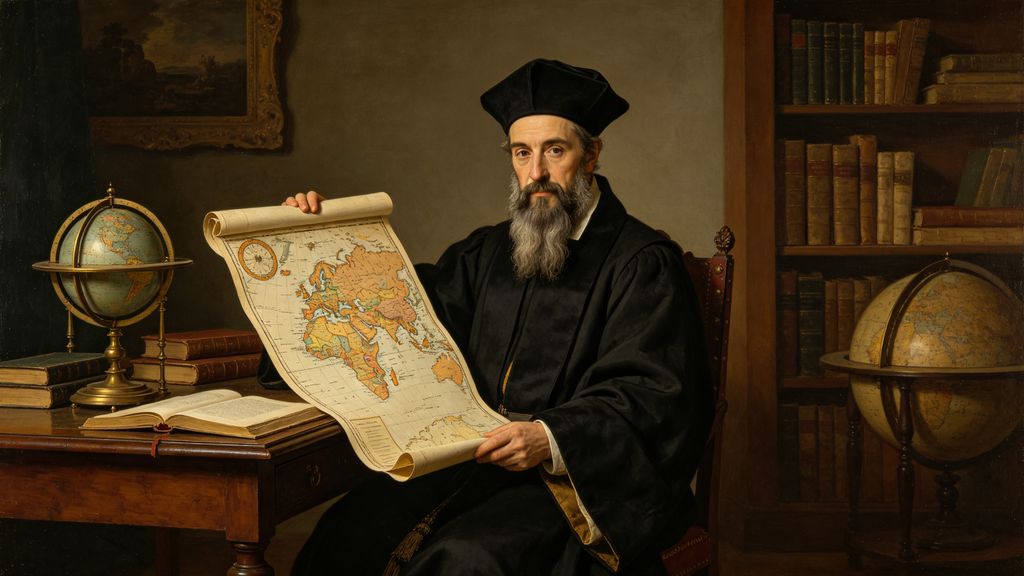
Matteo Ricci (1552-1610) was an Italian Jesuit who arrived in China in 1582 and lived there 28 years — one of the most important figures in Sino-Western cultural exchange.
Localization strategy: he learned Chinese, wore Confucian scholar's robes and studied the classics, integrating as a "Western Confucian" — the key to reaching the imperial court.
Scientific legacy: with Xu Guangqi he translated Euclid's Elements into Chinese (the foundation text of Chinese mathematics), drew the Kunyu Wanguo Quantu (the first Chinese world map), and brought clocks, telescopes and other Western instruments.
Cultural bridge: he introduced Europe to China's examination system and Confucian thought, profoundly shaping how Enlightenment thinkers like Leibniz and Voltaire imagined China.
After death: Ricci died in Beijing in 1610 and was granted rare permission to be buried there; his tomb, in the Beijing Administrative Institute compound, survives intact.
Matteo Ricci, Italian Jesuit who came to China during the Ming dynasty, known as "the first man of Western learning spreading East" - bringing Western mathematics, astronomy, geography and mechanical knowledge into China.
His strategy: he knew he must first become a "China expert" - studying Chinese hard, reading the classics, wearing Confucian robes; literati called him "the Western Confucian".
Scientific contributions: he drew Kunyu Wanguo Quantu, first showing Chinese readers the world five continents; with Xu Guangqi he translated Euclid Elements, introducing Euclidean geometry systematically.
Astronomy and calendar: he brought European instruments and calendar knowledge, helping reform the Chinese calendar and training Chinese scholars in Western science.
Cultural exchange: his letters described China politics, culture and technology in detail, giving Europe its first fuller picture of China. A model of two-way transmission.
Significance: he proved real cultural transmission is not condescending "output" but first humbly learning the other side, then exchanging as equals.
Influence: the scientific seeds he planted blossomed in the late Ming and early Qing - later scientists like Xu Guangqi and Li Zhizao were influenced by him.
For readers: his story shows knowing the other side is the first step toward mutual understanding.
Ricci did something special: after nearly thirty years in China, he requested burial according to Chinese rites - the emperor exceptionally granted him a plot, extremely rare in Chinese history. His tomb remains near Chegongzhuang in central Beijing, listed as a protected heritage site. People visit to honour this Italian who bridged cultures with science and learning. His story tells later generations: true cultural exchange is mutual respect and learning - friendship across five hundred years.
Flowers often appear at his tomb; a scholar wrote "he came not to preach but to converse." That sentence is his best memorial.
With a lifetime he proved a simple truth: the best bridge between cultures is respect and curiosity.

