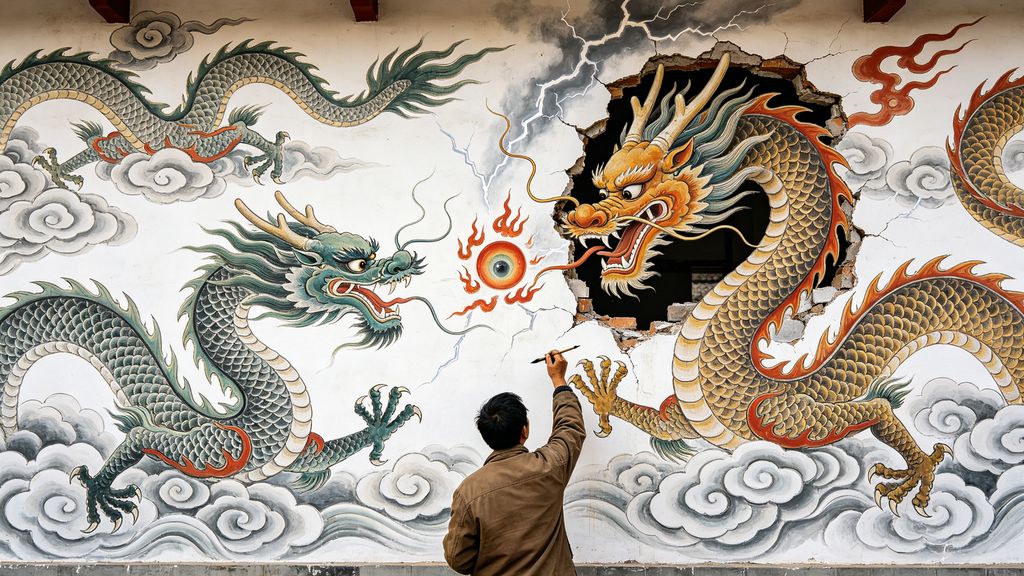
The idiom "Dotting the Dragon's Eyes" comes from the Tang-dynasty Record of Famous Painters, about the Southern-Dynasty master Zhang Sengyao.
The story: Zhang painted four dragons on a wall of Anle Temple in Jinling but left out their eyes, warning that with eyes the dragons would fly away. The crowd thought it absurd and insisted. The moment he dotted two dragons' eyes, thunder crashed and the two burst through the wall and flew off; the two un-eyed dragons stayed on the wall.
The meaning: a stroke or two at the vital point brings the whole thing to life. "The dotting-the-eye stroke" now means the crucial, brilliant finishing touch.
Usage: the last line of an essay, the closing of a speech, a detail in design — all can be "dragon-dotting". It also describes a master acting decisively at the critical moment.
Cultural bonus: dragons are "alive only with eyes"; in carving and painting, the eyes are deliberately finished last, in a ritual called "kaiguang".
"Huà lóng diǎn jīng" is a classic about art and the key point. The protagonist is Southern-Dynasties painter Zhang Sengyou.
Legend says he painted four dragons on a wall but no eyes. Asked why, he said: "with eyes, the dragons will fly away." Nobody believed; he dotted two.
Instant thunder and lightning - the two eyed dragons soared into the sky; the two eyeless stayed quietly on the wall.
First recorded in the Tang-era Record of Famous Paintings, for centuries "huà lóng diǎn jīng" has been the Chinese term for the key stroke.
It means: applying effort at the vital point brings the whole work or matter alive - a title, an opening line, a seasoning.
Today it praises the "finishing touch" - a detail or sentence that changes everything. It reminds us: it is not quantity but precision that matters.
For learners it is expressive wisdom: focus beats coverage; one accurate sentence outweighs ten vague ones.
Remember: a dragon without eyes is dead; words without focus are empty. Find your dotting point and you find the power that brings everything alive.
Besides "the key stroke", the tale teaches: skill is the premise. Zhang dared to say "eyes make dragons fly" because he truly had the skill.
Without real skill, dotting is random drawing; with skill, it is magic. So before pursuing "finishing touches", master the basics.
Learning Chinese is the same: accumulate vocabulary and grammar first, then refine expression. With solid basics, every sentence can be a dotting stroke.
Chinese art says "xiōng yǒu chéng zhú" - before painting, have the complete bamboo in your heart. Same as Zhang and his dragons: solid foundation first, astonishing stroke later. So "dotting the eye" is not a trick but a realm: when you know a thing to perfection, every move is a dotting stroke. Learning Chinese: practise basics until "bamboo in chest", and every sentence you speak will be natural, accurate, powerful. Then you are the painter who makes dragons fly.

