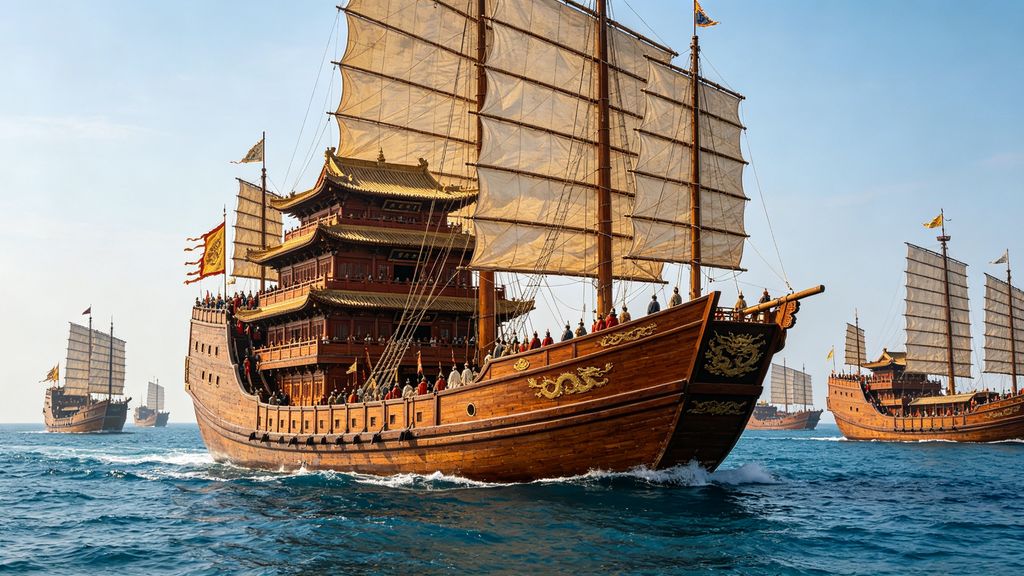
Between 1405 and 1433, the Ming admiral Zheng He led a colossal fleet on seven voyages to the "Western Ocean" — about 87 years before Columbus, and on an incomparably larger scale.
The fleet: some 200-300 ships and over 20,000 men per voyage; the flagship "treasure ship" stretched about 120 meters — the largest wooden sailing ship of its time.
The routes: from Nanjing, through Southeast Asia and the Indian Ocean, reaching as far as the east African coast (Somalia, Kenya) — 30-plus countries and regions visited.
Purpose and legacy: primarily peaceful diplomacy — projecting Ming prestige, tributary trade, and bringing home exotic goods. The voyages also spread Chinese porcelain, silk and navigation know-how.
Echoes: Zheng He's expeditions predate Europe's Age of Discovery by half a century and reveal China's former maritime ambition — today they're often cited as a symbol of peaceful exchange, including under the Belt and Road initiative.
Six hundred years ago, in Ming-dynasty China, a huge fleet sailed the seas seven times, reaching as far as the east African coast. Its commander was the navigator Zheng He.
Zheng He (1371-1433), originally surnamed Ma, was a Hui from Yunnan. Entering the palace young, he became one of the Yongle emperor most trusted generals and was granted the surname Zheng.
In 1405 he sailed on his first voyage with over two hundred large ships and more than twenty-seven thousand men. The largest "treasure ship" stretched over a hundred metres - several football fields - the largest ships on earth then.
Why did the emperor send him? To display Ming might abroad and incidentally seek the vanished Jianwen emperor. His fleet was more a "peace fleet".
Zheng He made seven voyages over twenty-eight years, reaching more than thirty countries and regions: today Vietnam, Thailand, Indonesia, India, Sri Lanka, the Arabian Peninsula, and as far as Kenya in east Africa.
Unlike Western colonists, Zheng He did not plunder. He delivered gifts, traded, and invited envoys to visit China. Many states forged friendly ties with China.
His navigational technology led the world: compasses, the specialised Zheng He Navigation Chart, and experienced pilots.
His voyages preceded the European age of discovery by nearly a century. When Columbus reached America in 1492, Zheng He had already completed six voyages.
His final voyage began in 1431; he died at sea on the return. People say he gave his whole life to the ocean.
After him the Ming gradually abandoned long voyages, and his navigation archives were destroyed - a lasting regret in Chinese history.
Today Zheng He symbolises peaceful exchange. In many Southeast Asian nations, temples called "Sanbao temples" still honour him.
The name Zheng He stands for openness, friendship and exploration. That voyage six centuries ago showed the world: when China took to the sea, it carried friendship, not conquest.
If you learn Chinese and want to know China, Zheng He is essential reading - proof that humanity can travel far in many ways.

