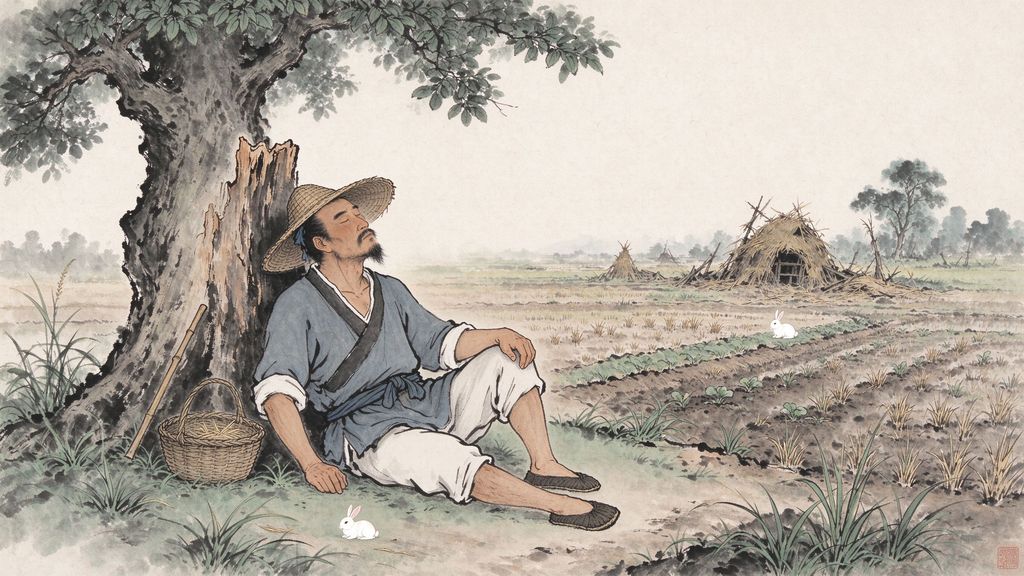
Once, a farmer was working in his field when a rabbit ran by, hit a tree and died. The farmer was delighted and took it home for dinner.
He thought: if I can pick up a rabbit every day, I don't need to farm! So he stopped working and sat under the tree every day, waiting. But no rabbit ever hit the tree again. Weeds grew in his field and he harvested nothing.
The idiom 'shou zhu dai tu' means: you cannot succeed by waiting for luck without effort. The same is true for learning — don't wait for a free lunch; work hard yourself.
The story: in the state of Song a farmer was working in his field when a rabbit ran too fast, hit a tree stump and died. He picked it up, decided luck would keep coming, stopped farming and waited by the stump every day for another rabbit. None ever came, his field went to waste, and he became a joke across the state.
The idiom literally means "guarding the stump, waiting for rabbits". It mocks people who treat a lucky accident as a rule of nature, refuse to work and expect gains without effort.
Usage: "study cannot mean waiting by a stump; you must seek methods yourself" or "he keeps waiting for pie to fall from the sky - is that not guarding the stump?" It pairs with phrases meaning reaping without sowing.
The story comes from Han Feizi, where the Warring States thinker Han Fei used it to attack those who insisted on governing the present with the ways of ancient kings. His point: times change, methods must change, and clinging to old experience fails. That lesson still resonates.
English has no exact equivalent, but "waiting for a windfall" or "wishful thinking" come close. To explain to foreign friends: it means hoping for good luck without doing any work. The little story makes it clear instantly.
Memory trick: picture a man dozing against a stump with the four characters written beside him. Next time you feel like waiting on luck, recall the wasted field and act instead.
Hold the idiom as an image: a man leaning on a stump, eyes on the sky, beside a field choked with weeds. It reminds us luck may strike once, but life cannot run on luck. Whatever you want, pursue it - prepare, act, and make it happen.
In Chinese classes and cultural exchanges, this idiom is often a discussion question: where did the farmer go wrong? The standard answer is not "bad luck" but "he mistook chance for certainty and stopped trying". So the idiom is a reminder - luck needs effort to catch it, and opportunities always favour the prepared.
Long ago, a farmer in the state of Song had a tree in his field. One day a rabbit ran fast, hit the tree and died. The farmer picked it up effortlessly, overjoyed.
From then on he stopped farming - putting down his hoe, sitting by the stump daily, waiting for another rabbit. But days passed; no rabbit came, and his field lay waste.
The story comes from Han Feizi, one of the most familiar idiom tales in China. It mocks those who treat accidental luck as a law, reminding us that gain without effort never lasts.
The English sense: "waiting for a rabbit by a tree stump" - if you do not work and only wait for a windfall, you end up with nothing.
Today the idiom describes two kinds of people: those who refuse to work and only chase luck; and those who cling to old ways and resist change. Neither is good.
For Chinese learners the story is easy to remember - it is about luck versus effort. Luck may come once, but real harvest always comes from daily toil.
If you also want "rabbit" luck, the best way is not sitting by a stump but tending your own field. Opportunities favour the prepared.
It is also used to advise against clinging to outdated experience. The stump-waiter ends with not a rabbit but a wasted field.

