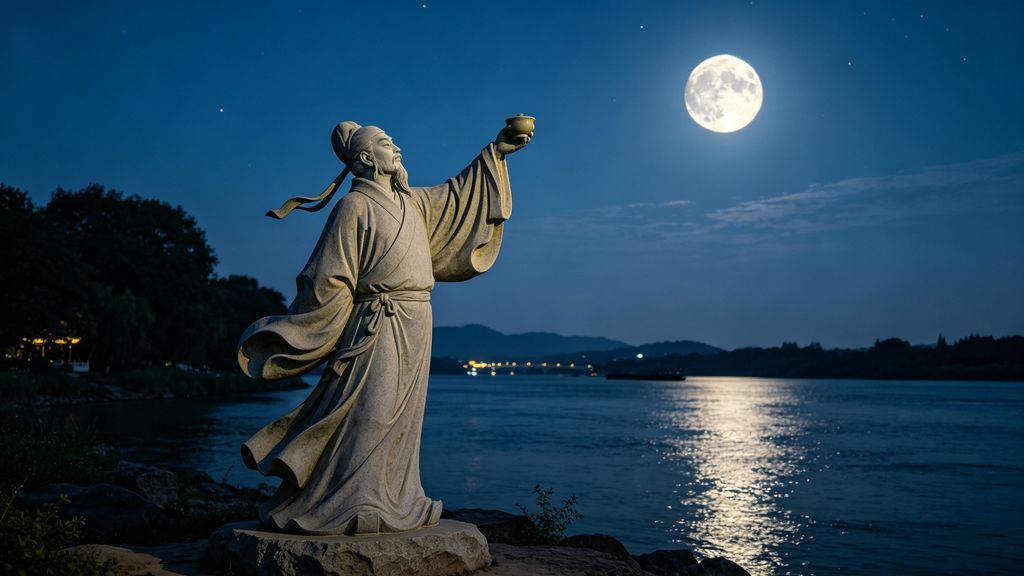
Li Bai is China's most famous poet. He lived in the Tang Dynasty, more than 1,300 years ago. He loved wine, travel and the moon. People called him the 'Poet Immortal' because his poems are as free as a god's.
Li Bai wrote many poems that every Chinese student can recite. 'Jing Ye Si' (Thoughts on a Quiet Night) reads: 'Before my bed the silver moonlight glows, as if it were white frost upon the ground. I raise my head to watch the moon, then lower it to think of home.'
His poems are simple but full of images. Drinking alone, he would 'raise my cup and invite the moon, with my shadow making three of us'. His story tells us: live freely and keep your dreams.
Introducing the man: Li Bai (701-762), courtesy name Taibai, the great Tang poet honoured as the "Poet Immortal". He left nearly a thousand poems of bold, free-flowing style and wild imagination - the peak of Chinese romantic poetry.
Three must-know poems: Jing Ye Si - "Bright moonlight before my bed, I suspect frost on the floor. Lifting my head I watch the moon, lowering it I think of home" - every Chinese person can recite it; Looking at the Waterfall on Mount Lu - "It flies straight down three thousand feet, as if the Milky Way falls from the ninth heaven"; Invitation to Wine - "Heaven gave me talents, they will surely be used; a thousand in gold spent, it will come back again."
His life matched his verse: in youth he roamed the land with a sword, drinking and writing with friends. Summoned to Chang an by Emperor Xuanzong, he served in the Hanlin Academy but could not stand court constraints and eventually left. His final years were spent wandering; legend says he drowned reaching for the moon in a river while drunk - a very "Li Bai" ending.
His style: love of exaggeration and imagination, and of wine, moon, swords and mountains. Sorrow becomes "three thousand feet of white hair", a waterfall the "Milky Way falling from heaven", solitude "raising my cup to invite the bright moon, with my shadow making three". To read Li Bai, let go of logic and follow his flight of fancy.
Places linked to him: Jiangyou in Sichuan is his hometown with a memorial hall; Dangtu in Anhui holds his tomb; Mount Lu in Jiangxi has the waterfall from his poem; Caishi Rock in Ma anshan is said to be where he reached for the moon. Fans can follow the "Poet Immortal Road".
How to read him: beginners should memorise Jing Ye Si first to feel the rhythm, then Invitation to Wine for the wild spirit, and later try a bilingual anthology. You need not understand every line - enjoy the sound and images, and the beauty of the poems will surface by itself.
One last suggestion: connect Li Bai with travel. On the road in China, match lines to the scenery - from a tower think of "to see a thousand li, climb one storey more"; at the moon, "lifting my head I watch the bright moon". Poetry lives not in books but in landscapes - that is how Chinese people read it.
There is a modern lens for enjoying Li Bai: he was among the first to put the individual into poetry. Before him, verse mostly dealt with courts, war or the state; Li Bai boldly wrote his own passion, solitude and dreams. People love him today not only for beautiful lines but because he lived out freedom and authenticity - a quality that still moves us after 1,300 years.

