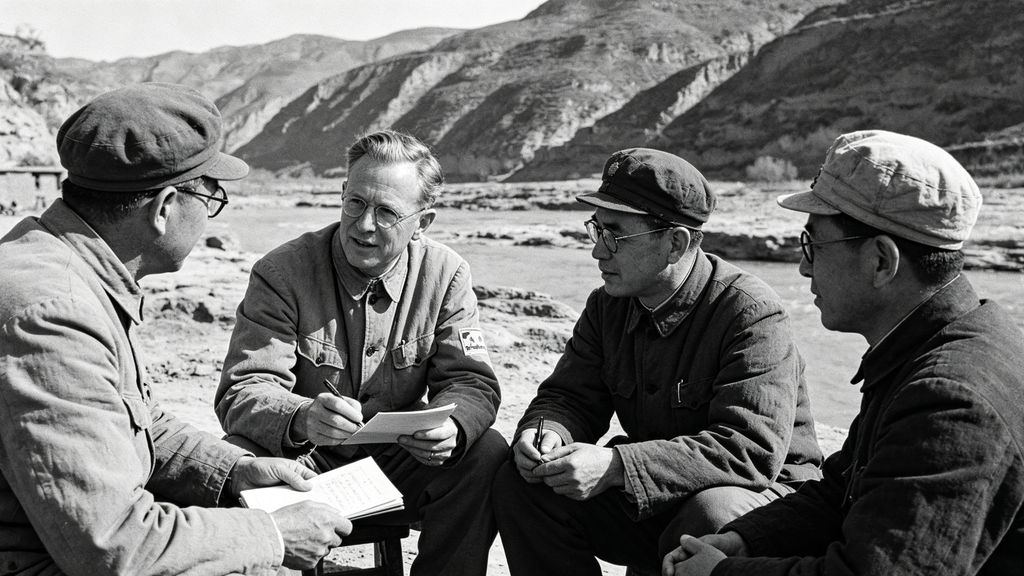
Edgar Snow (1905-1972) was an American journalist and author. In 1936, he ventured into the red base area in northern Shaanxi—at that time, the KMT had tight news blockade on the Communists, and the outside world had no idea the Red Army was there. Snow was the first Western journalist to interview the red base area; he stayed in Bao'an (today's Zhidan County) for four months, interviewing Mao Zedong, Zhou Enlai, Zhu De, and other leaders.
In Bao'an, Snow had long talks with Mao Zedong. Mao told the outside world his own life story for the first time, and the story of the Red Army's 25,000-li Long March. Snow lived with Red Army soldiers, watched them train, eat, and hold evening parties. He found that these Red Army soldiers in ragged clothes eating millet were completely different from the "bandits" the KMT described—they had faith, ideals, and discipline.
In 1937, Snow's "Red Star Over China" (also known as "Journey to the West") was published in Britain and immediately caused a sensation worldwide. This book was the first to truly introduce the Chinese Communist Party and the Red Army to the world. Many young people read this book and resolutely went to Yan'an to join the revolution. Today this book has been translated into dozens of languages and sold tens of millions of copies.
After the founding of New China, Snow visited China three times, and Mao Zedong had long talks with him. On National Day 1970, Snow also stood on Tiananmen Gate beside Mao Zedong. This was an important signal—the US and China were approaching. Two weeks before Nixon's 1972 visit to China, Snow died in Switzerland. He didn't live to see Sino-US normalization, but he had already laid the most important groundwork for that day.
Snow was a true journalist—he didn't take sides, only told facts; he wasn't afraid of danger, going wherever the truth was. He introduced a blockaded, misunderstood Red China to the world. Today, reading his book, we can still feel the passion and ideals of that era.
Edgar Snow, American journalist who broke through the blockade into northern Shaanxi in 1936 and wrote Red Star Over China, introducing the Chinese Communist Party and the Red Army to the world for the first time.
His adventure: in 1936, risking his life, Snow crossed Kuomintang lines into the Shaanxi Soviet, interviewing Mao Zedong, Zhou Enlai and others, and recording Red Army soldiers daily life.
His work: in 1937 he published Red Star Over China - first-hand material telling the world the true situation of the revolutionary base areas, dispelling rumours about the Party.
His influence: the book caused a sensation in the West; many young foreigners were drawn to China because of it, some even joining the revolution. It helped the world understand why the Chinese revolution succeeded.
His stance: not a detached observer - he recorded China with sympathy and a search for truth; his reporting is still cited by historians.
Significance: he represents international friends witnessing China - showing truthful, objective reporting can bridge China and the world.
Commemoration: part of his ashes rest in China, with a grave by Peking University Weiming Lake. The Chinese people remember this sincere American friend.
For readers: his book shows - real understanding comes from field visits, listening and unbiased eyes.

