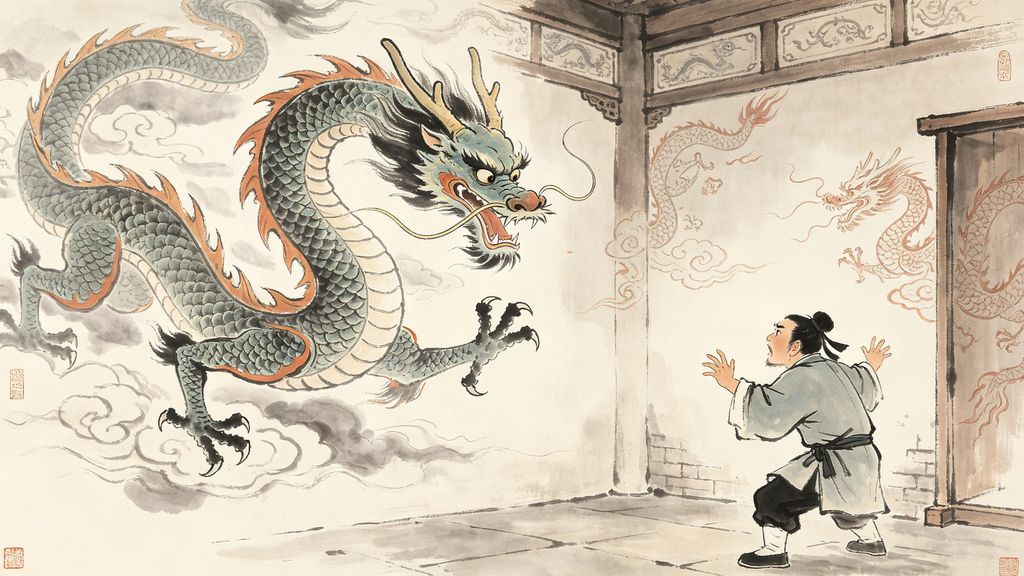
In ancient times there was a Lord Ye who loved dragons very much. His clothes were embroidered with dragons, his hats carved with dragons, and his walls, pillars, doors, and windows were all painted with dragons. He told everyone he met: "I love dragons the most!"
The real dragon in the sky heard about this and was very happy, thinking: someone actually loves me this much, I should go visit him. So the real dragon came down from the sky, flew to Lord Ye's window, and poked its head into the room.
Lord Ye looked up and saw the real dragon, and his soul nearly flew out of his body. His face turned white, he turned and ran, faster than a rabbit. He didn't love dragons at all—he only loved things that looked like dragons but weren't actually dragons.
The real dragon went back disappointedly. It turned out Lord Ye didn't love real dragons at all, only dragon-like patterns.
This is the story of "Lord Ye loves dragons." It means someone who appears to love something but doesn't actually love it—even fears it. In life, we see many "Lord Yes"—they say they love something, but when asked to actually do it, they back off.
The tale: in the Spring and Autumn period, a man of Chu called Lord Ye loved dragons. His walls, pillars, robes and cups all bore dragons.
The real dragon in heaven, moved that Lord Ye loved dragons so, decided to visit him. One day the true dragon came, head through the window, tail in the hall.
Lord Ye was terrified, turned and ran, face drained of colour. What he loved was not the real dragon but painted, false ones.
The story comes from Liu Xiang Han-dynasty Xinxu, mocking those who "love on the surface, fear in reality".
"Yè gōng hào lóng" means: claiming to love while secretly fearing; professing interest without true understanding or acceptance.
Today it criticises "fake hobbies": claiming to love traditional culture while never studying it; claiming to love reading while pages stay unturned; claiming to support the environment while littering.
It reminds us: true love is action, not slogans. Love something - go understand it, approach it, give to it.
For learners it is a good reminder: if you say you love Chinese, study it daily - do not be a Lord Ye; be a friend of the real dragon.
The tale became the name for "fake passion". Today there are many "Lord Ye": want to learn an instrument, buy one and leave it in a corner; want to exercise, buy a card and go three times.
How to tell true passion from fake? Look at action. Those who truly love Chinese open their textbook daily; those who truly love travel buy tickets and go.
If you truly love Chinese, start today with a small thing: read a page, write a sentence, memorise three words. Action proves passion.
The tale has a deeper reading today: love must withstand tests. Love a person, accept all of them; love a language, accept its difficulties - hard characters, hard sounds. Lord Ye loved only pictures of dragons, not the dragon itself. If you love Chinese, love its difficulties too. When you befriend the "hard", you truly approach the dragon.

