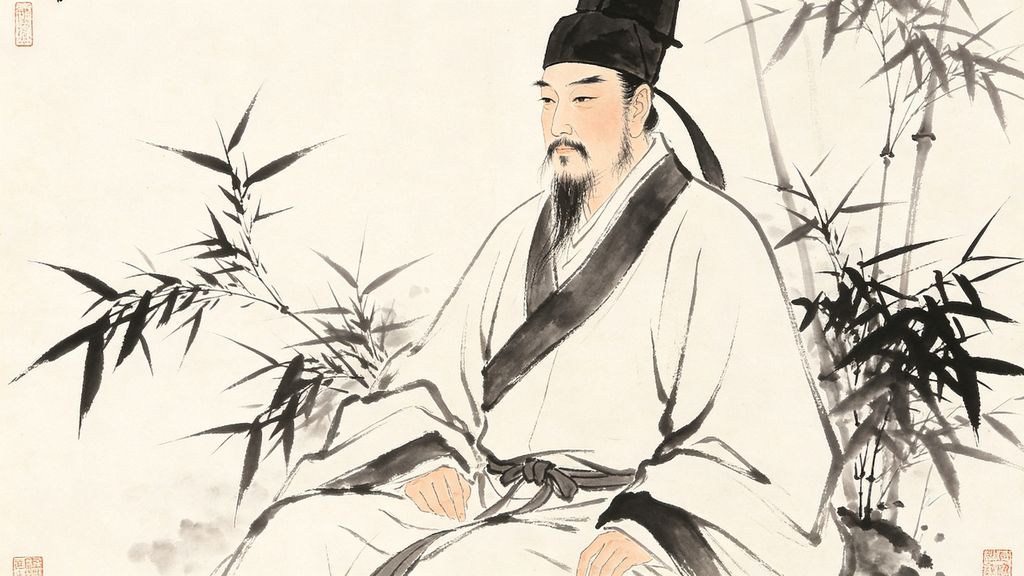
Su Shi (1037-1101), courtesy name Zizhan, art name Dongpo Jushi, known as Su Dongpo. He was the greatest writer, calligrapher, and painter of the Northern Song dynasty, and also a foodie. His poetry, lyrics, essays, calligraphy, and painting were all masterful—one of the few all-round talents in Chinese history.
Su Shi's life was either being demoted or on the way to being demoted. Because he opposed Wang Anshi's reforms, he was demoted again and again—from Kaifeng to Hangzhou, to Huangzhou, to Huizhou, and finally to Danzhou on Hainan Island. In those days, Hainan was a barbarian land—being sent there was basically exile.
But Su Shi was a natural optimist. Demoted to Huangzhou, he found pork was cheap and invented "Dongpo pork." Demoted to Huizhou, he wrote "Eating 300 lychees a day, I wouldn't mind staying in Lingnan forever." Demoted to Hainan, he still set up schools and taught, becoming the pioneer of Hainan culture.
Su Shi is most famous for his ci poetry. He founded the bold and unconstrained school of ci. "The great river flows east, its waves washing away all the heroes of ages," "When does the bright moon appear? I raise my cup to ask the sky"—these poems are magnificent and have been passed down for centuries. Together with Xin Qiji, he is the representative of the bold ci school.
Su Shi was not just a great writer—he was a master of life. He could cook, brew wine, build houses, and farm. He wrote "Ode to Pork," "Ode to Vegetable Soup," and "Ode to the Glutton." Today when you go to Hangzhou, you can still eat authentic Dongpo pork. A man who was exiled his whole life, yet remained so optimistic and knew how to live—this is the charm of Su Dongpo.
Su Shi (1037-1101), courtesy name Zizhan, style Dongpo Jushi, is a great Northern Song literatus - a rare polymath: poet, ci lyricist, essayist, calligrapher, painter, gourmet and statesman. His life swung wildly, yet he stayed optimistic and open-minded - the benchmark of an "interesting soul" in Chinese hearts.
Literary achievements: he pioneered the heroic school of ci. Nian Nu Jiao: Remembering the Past at Red Cliff - "the great river flows east, waves washing away the ages famous men" - is magnificent; Shui Diao Ge Tou - "may we live long and share this moonlight a thousand li apart" - captures Mid-Autumn feeling; the prose Red Cliff Ode is called "a song for the ages". He reached the top tier in poetry, ci, prose, calligraphy and painting.
Life ups and downs: his official career was disastrous - nearly executed in the Crow Terrace poetry case, then exiled to Huangzhou, Huizhou and Danzhou (today Hainan). Yet he turned every hardship into flavour: farming in Huangzhou as "Dongpo the lay Buddhist", inventing Dongpo pork; in Huizhou "eating three hundred lychees a day, content to be a Lingnan man"; in Danzhou founding schools to spread culture.
"A straw cloak through mist and rain": the best note on his open-mindedness. To wind and rain he answered, "bamboo staff and straw sandals are lighter than horses - who is afraid? A straw cloak through mist and rain, I walk my life"; to blows, "going home - no wind, no rain, no sunshine". This poise beyond praise and blame made him the symbol of the Chinese literati spirit.
Su Shi and food: Dongpo pork, Dongpo elbow and Dongpo cake bear his name; he wrote "in this world the tastiest is pure joy" and made ordinary life poetry. Today Hangzhou Dongpo pork, Huangzhou Red Cliff and Huizhou West Lake all connect to his name.
Places: Sansu Shrine in Meishan, Sichuan (the Su family home), Dongpo Red Cliff in Huanggang, Hubei, Su Causeway in Hangzhou (built while he was prefect), and Dongpo Academy in Danzhou, Hainan. The roads Su Shi walked are the spiritual map of the Chinese literati.

