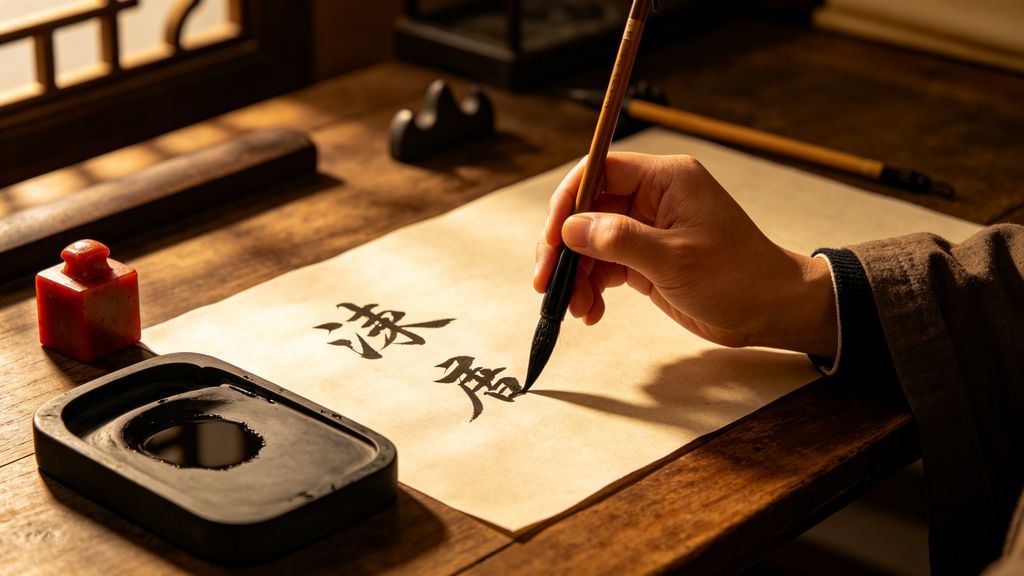
For Chinese people, writing is not just writing—it's an art form: calligraphy. One brush, a stack of rice paper, a drop of ink—a calligrapher can create endlessly varied lines. Great calligraphy works are museum-quality collectibles worth a fortune.
There are five main script styles: seal, clerical, regular, running, and cursive. Seal script is the oldest, with uniform lines. Clerical script is wide and flat, with "silkworm head and swallow tail" strokes. Regular script is the standard we know today—neat and precise. Running script is between regular and cursive, the most practical. Cursive is the most fluid and artistic, but hard for ordinary people to read.
Why do Chinese people value calligraphy so much? Because they believe "the writing shows the person." A person's handwriting reveals their character, cultivation, and mood. Neat regular script suggests an upright personality; wild cursive suggests a free spirit. That's why ancient scholars practiced calligraphy from childhood—bad handwriting was looked down upon.
What are the benefits of practicing calligraphy? First, it calms the mind. When writing brush calligraphy, you must be fully focused, with no distracting thoughts, only paying attention to the lines under your hand. It's like meditation. Second, it develops aesthetic sensibility—you become more sensitive to lines, structure, and rhythm.
If you're interested in calligraphy, start with regular script, using model books by Ouyang Xun, Yan Zhenqing, or Liu Gongquan. You don't need expensive tools—one brush, a stack of practice paper, and an ink bottle, under 50 yuan to start. Write 15 minutes a day for three months, and you'll feel the difference.
In China, writing is not only communication but an art. Chinese call writing "calligraphy" and regard it, like painting and music, as a high art form.
Why do Chinese treat writing as art? Because Chinese characters themselves carry beauty: square, balanced structure, endlessly varied strokes. Whether a character is written well is visible at a glance.
Chinese calligraphy has over three thousand years of history. The earliest works were carved on bronze and stone, later written on bamboo slips and paper. From Wang Xizhi to Yan Zhenqing, countless calligraphers spent lives pursuing "writing well".
Calligraphy values "brush technique": starting, moving, finishing each stroke by rules; and "composition": spacing between characters and lines, rhythmic like music.
Most magical: calligraphy expresses emotion - joy makes strokes flow and soar; anger makes them forceful and bold; calm makes them neat and warm. Hence "the writing shows the person".
Calligraphy relates to health: practise standing stable, sitting straight, mind calm, like tai chi - excellent self-cultivation. Many elders write daily and grow more spirited.
Now calligraphy has gone global as a window into China. Foreign learners often begin by writing their Chinese names. The first wobbly stroke is often the most memorable.
If you want to learn, follow the order: grip the brush, practise strokes, then whole characters. Twenty minutes daily; in a month you will be pleasantly surprised.
Calligraphy is the "quiet art" China gives the world. Writing is also writing the heart.

