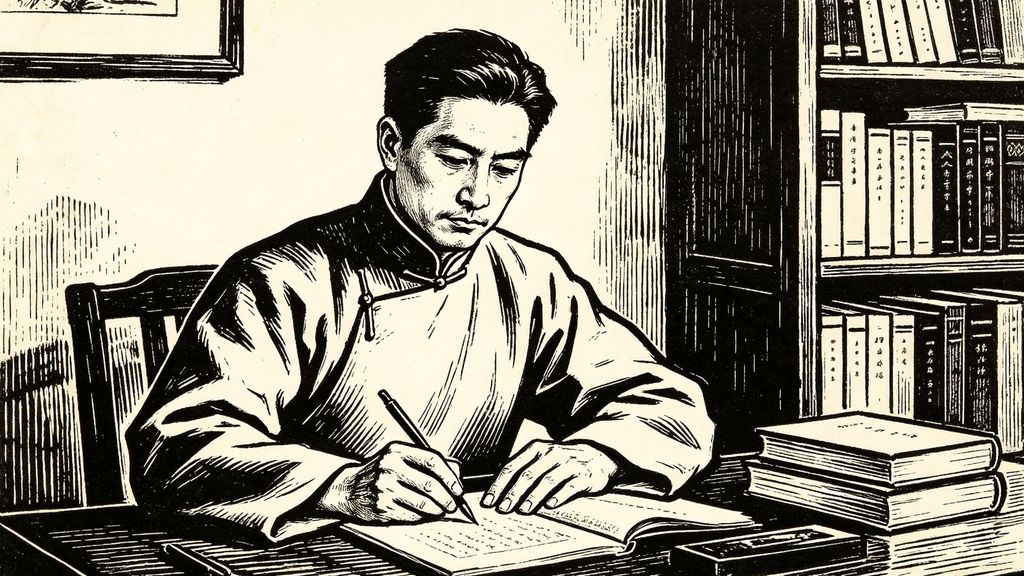
Lu Xun (1881-1936), original name Zhou Shuren, from Shaoxing, Zhejiang. He is the founder of modern Chinese literature, known as the "National Soul." His novels, essays, and critical writing deeply exposed the social ills of old China, influencing an entire generation. Works like "Diary of a Madman," "The True Story of Ah Q," and "New Year's Sacrifice" are all in school textbooks.
Lu Xun originally studied medicine. While at Sendai Medical School in Japan, he saw a slide show: a Chinese man being executed as a Russian spy by the Japanese, surrounded by onlooking Chinese who watched numbly. This shocked him—he realized medicine could not save China; spiritual illness was worse than physical illness. So he abandoned medicine for literature, determined to awaken the nation through writing.
In 1918, Lu Xun published "Diary of a Madman," the first modern Chinese short story in vernacular language. The "madman" reads through history, which is filled with "benevolence and morality," but between the lines are two words—"eating people." This metaphor was revolutionary, sharply pointing out the essence of feudal ethics for the first time. After that, Lu Xun wrote a flood of novels and essays.
Lu Xun's writing is sharp and incisive. He attacks feudal ethics, numb onlookers, hypocritical moralists—everything bad. His famous line: "Head bowed, I willingly serve the children like an ox; brow raised, I defy the thousand pointing fingers"—this is his self-portrait: unyielding to enemies, willing to serve the people like an ox.
On October 19, 1936, Lu Xun died in Shanghai at age 55. His coffin was covered with a flag reading "National Soul." Today, Shaoxing (his hometown) has Lu Xun Native Place and Memorial Hall; Shanghai has Lu Xun Park. His writing may seem difficult at first, but once you understand it, you'll know why he's called the "National Soul."
Lu Xun (1881-1936), originally Zhou Shuren from Shaoxing, Zhejiang, is the founder of modern Chinese literature and a banner of the New Culture Movement, called by Mao Zedong "the chief commander of China cultural revolution" and "the soul of the nation".
Abandoning medicine for writing: studying medicine in Japan, he saw Chinese onlookers watch the execution of a compatriot with numb indifference. He realised "medicine cannot save the Chinese spirit" and turned to literature to awaken the nation - a decision that changed the course of modern Chinese letters.
Achievements: he wrote the first vernacular short story in modern Chinese literature, A Madman Diary (1918), exposing the "cannibalistic" essence of feudal rites; The True Story of Ah Q created the famous "spiritual victory" figure; the collections Call to Arms and Wandering founded the modern Chinese story; his essays are called "javelin and dagger".
Famous lines: "Facing a thousand pointing fingers, I defy them; bowing like a willing ox, I serve the children." "There was never a road in the world; when many people walk, a road appears." "Since ancient times we have had people who toil in silence, who fight hard, who plead for the people, who sacrifice themselves for truth - these are the backbone of China."
His legacy: he is not only a monument of Chinese literature but a mirror. The national weaknesses he dissected (numbness, self-deception, bystander mentality) remain subjects of Chinese self-reflection; his encouragement for youth to "boldly walk your own road" inspires generation after generation.
Places: Shaoxing Lu Xun hometown (Hundred Plants Garden, Sanwei Study), Beijing Lu Xun Museum, Shanghai Lu Xun Memorial (Hongkou), Guangzhou Lu Xun Memorial. Following his footsteps is a profound lesson in modern Chinese history.

