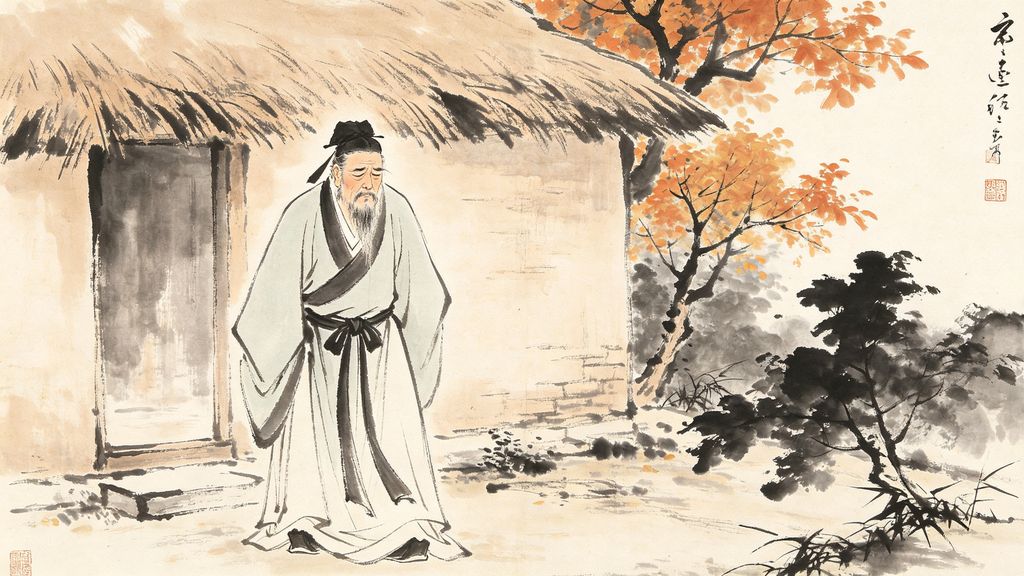
Du Fu (712-770), courtesy name Zimei, is known as the "Poet Sage." Together with Li Bai, they are the two greatest poets in Chinese history—known together as "Li Du." But unlike Li Bai's romantic freedom, Du Fu's poetry is always somber and heavy, filled with concern for his country and people. His poems are called "poetic history" because they faithfully record the Tang dynasty's decline from prosperity to chaos.
Du Fu also traveled and enjoyed mountains and rivers when young, like Li Bai. But he was born at the wrong time—he lived through the An Lushan Rebellion, a war that shattered the Tang dynasty's golden age. Du Fu witnessed the cruelty of war and the suffering of ordinary people. His famous poems "Three Officials and Three Departures" describe the miserable lives of civilians during the war.
His most famous poem, "Spring View": "The nation broken, mountains and rivers remain. The city in spring, grass and trees grow thick. Moved by the times, flowers shed tears. Hating separation, birds startle the heart." The country is shattered, only mountains and rivers remain; spring comes, but the city is overgrown with weeds. Seeing flowers makes him cry; hearing birds startles him. This is Du Fu—his poetry always carries the weight of ordinary people.
Du Fu was extremely poor in his later years. He lived in Chengdu for a few years, helped by his friend Yan Wu, and built a cottage by the Flower Rushing Stream—today's Du Fu Thatched Cottage in Chengdu. After Yan Wu died, Du Fu became a wanderer again, eventually dying on a boat. He spent his whole life writing poems for others, yet was too poor to feed himself.
Though unsuccessful in life, Du Fu was increasingly revered after death. After the Song dynasty, he was honored as the "Poet Sage," and his poetry considered the highest model of Confucian literature. Today, Du Fu Thatched Cottage in Chengdu is a famous tourist site, visited by many who pay tribute to this great poet who worried about his country and people all his life.
Du Fu (712-770), courtesy name Zimei, is the great realist poet of the Tang, honoured as the "Poet Sage". His verse truthfully records the rise and fall of Tang around the An Lushan Rebellion and is called "poetic history". He pairs with Li Bai as "Li Du".
Life: born to an official, scholarly family - his grandfather Du Shenyan was a noted poet. Young, he roamed Wu-Yue and Qi-Zhao, writing the youthful "I must climb to the top and see all mountains small" (Gazing at Mount Tai). From 35 he languished ten years in Chang an, career stalled, writing "wine and meat rot behind vermilion gates, frozen bodies lie on the road". When the rebellion broke, he wandered and witnessed misery, producing his greatest works.
Masterpieces: Spring View - "the state is broken, hills and rivers remain; in the city spring, grass and trees grow deep; moved by the times, flowers shed tears; hating parting, birds startle the heart." The Three Officials and Three Partings record the people ordeal of war. Song of the Thatched Hut Broken by Autumn Wind: "when will a mansion of ten thousand rooms shelter all the poor scholars of the world?" - in his own broken hut, he dreams of housing the world poor.
His "people-ness": his poems always stand with ordinary folk - conscripts, partings, farmers, soldiers. He writes not only his own suffering but that of millions, earning the titles "poetic history" and "poet of the people".
Du Fu and Chengdu: in 759 he took refuge in Chengdu, building his thatched cottage beside Huanhua Brook for three years and writing 240-plus poems. The cottage is now Chengdu most important cultural landmark and a national first-grade museum.
How to read him: first Gazing at Mount Tai for youthful spirit, then Spring View for the pain of a broken country, finally the Thatched Hut song for all-embracing compassion. Read in the order of his life and watch a man grow into a Poet Sage.

