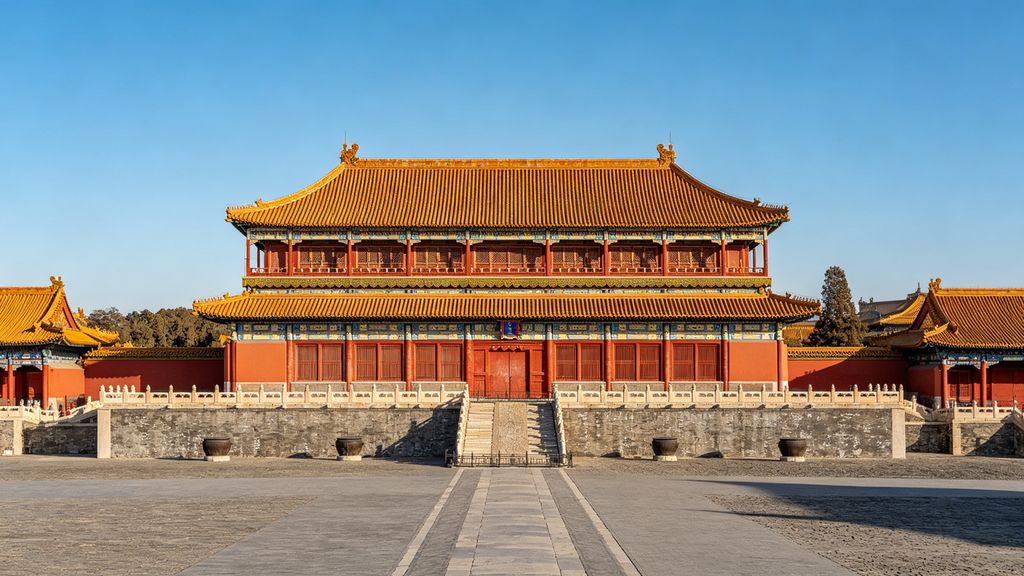
The Forbidden City in Beijing was the imperial palace of the Ming and Qing dynasties. From its completion in 1420 until Puyi moved out in 1924, 24 emperors lived here. Covering 720,000 square meters with over 9,000 rooms, it is the largest and best-preserved ancient wooden structure complex in the world.
Why is it called the "Forbidden City"? "Zi" refers to the Purple Star (Polaris), where the Heavenly Emperor lived in ancient astronomy. The emperor on earth was the "Son of Heaven," so his residence was the "Purple Palace." "Jin" means forbidden—ordinary people could not enter. Together it means "the emperor's walled city."
The architecture is strictly symmetrical. Along the central axis from south to north: Meridian Gate, Supreme Harmony Hall, Central Harmony Hall, Preserving Harmony Hall, Palace of Heavenly Purity, Hall of Union, Palace of Earthly Tranquility, Imperial Garden, and Gate of Divine Prowess. The Eastern and Western Six Palaces are symmetrically arranged on both sides, reflecting ancient China's hierarchical system and imperial authority.
On October 10, 1925, the Palace Museum officially opened to the public. Today, it receives over 10 million visitors a year, making it the most visited museum in the world. If you visit Beijing, set aside a full day for the Forbidden City—it is too big to see in half a day.
Enter from the Meridian Gate, walk along the central axis, then explore the Eastern and Western Six Palaces to see imperial life, and exit through the Gate of Divine Prowess. Across the street is Jingshan Park—climb to the top for the best panoramic view of the entire Forbidden City.
The Palace Museum, formerly the Forbidden City, stands at the centre of Beijing central axis - the largest and best-preserved ancient wooden palace complex in the world.
Construction began in 1406 (fourth year of Yongle) and finished in 1420 - over six hundred years old. Twenty-four Ming and Qing emperors lived here.
It covers 720,000 square metres with about 150,000 square metres of buildings, over seventy halls and more than nine thousand rooms.
The layout is strictly symmetrical: on the axis, the Halls of Supreme, Central and Preserving Harmony form the "outer court" for state affairs; behind, Qianqing Palace, Jiaotai Hall and Kunning Palace form the "inner court" for imperial life.
The Hall of Supreme Harmony is the grandest: eleven bays wide, about 35 m high, resplendent inside. Coronations, weddings and empress investitures took place here.
Roofs largely use yellow glazed tiles - yellow being the imperial colour; only a few buildings use green or black: princes palaces green, library pavilions black (black symbolises water, protecting against fire).
Its decorative art is superb: white marble balustrades, stone carvings, painted ceilings, gilded bronze lions - every detail exquisitely wrought.
It holds over 1.8 million artefacts, from Shang-Zhou bronzes and Tang-Song paintings to Ming-Qing porcelain - China largest museum.
The Palace Museum opened to the public in 1925. During the war, over 13,000 crates of relics were moved south across half of China and returned intact - a miracle of museum history.
It welcomes over fifteen million visitors yearly, 19 million in 2019; ticketing is now limited and by reservation for conservation.
Recent years made it vibrant: popular cultural products, the documentary Masters in the Forbidden City moving young viewers, and the corner-tower cafe a social-media hit.
In 2015 it celebrated six hundred years. Six centuries of weathering have not aged it but enriched its charm.
"Once inside the palace gates, all is deep" - the Forbidden City is not just architecture but the crystal of six hundred years of Chinese history, art and culture.

