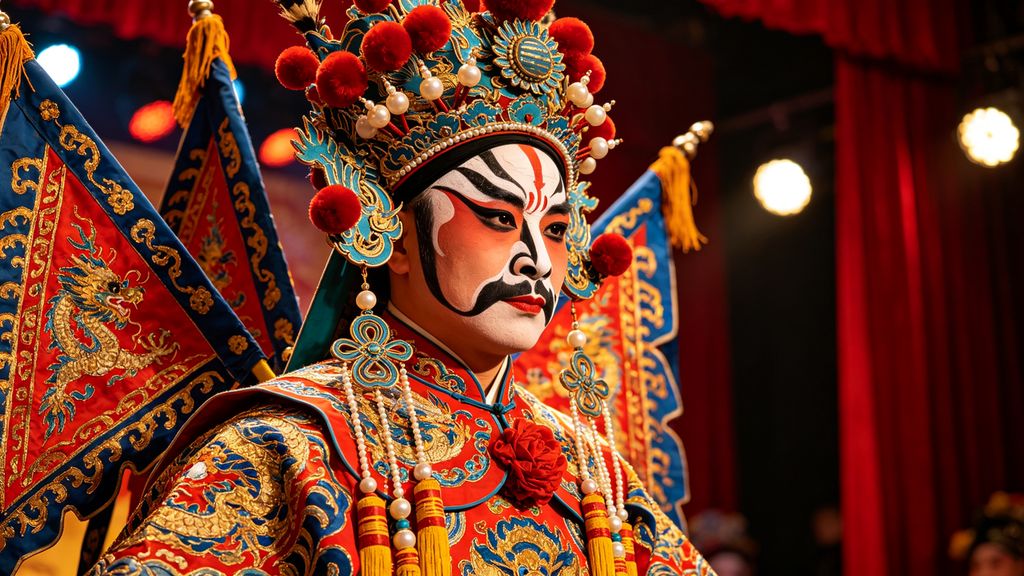
If you ask a foreigner what they think of when they hear "Chinese theater," nine out of ten will say "Peking Opera." This 200-year-old stage art is called China's "national treasure." Face paint, water sleeves, costumes, and gongs—everything about Peking Opera is uniquely Chinese. But many first-time viewers find it hard to follow. Actually, once you understand a few basics, it's not that hard to appreciate.
The most fascinating part of Peking Opera is the face paint. Different colors represent different personalities: red faces mean loyal (like Guan Yu), white faces mean cunning (like Cao Cao), black faces mean upright (like Judge Bao). When you see a face mask, you can tell if the character is good or bad just from the color—it's a unique Chinese "personality code" art form.
Peking Opera performance has four basic skills: singing, recitation, acting, and acrobatics. "Singing" is the musical part, "recitation" is spoken dialogue, "acting" refers to gestures and movements, and "acrobatics" is martial arts on stage. A good Peking Opera actor trains for over ten years from childhood. Every flip, every water sleeve movement you see on stage comes from thousands of hours of practice.
You don't have to watch a full opera from beginning to end. Start with classic excerpts (zhezi xi), like "Empty City Strategy" or "Farewell My Concubine," each about half an hour long, with English subtitles. Focus on the actors' expressions, hand gestures, and water sleeve movements—even without understanding the words, you can feel the emotion of the story.
Many cities now have Peking Opera experience workshops where you can put on costumes, get face paint, and take opera-themed photos. It's a great cultural experience. If you visit Beijing, be sure to catch a show at Chang'an Grand Theater or the National Centre for the Performing Arts. The thrill of live gongs and drums is something you can never experience on TV.
Peking opera, called the "national treasure" of China, is one of the proudest traditional arts. Over two hundred years old, combining song, speech, acting and acrobatics, it is one of the world three great performance systems.
How did it form? During the Qianlong reign of the Qing dynasty, regional troupes came to Beijing to celebrate the emperor birthday; southern Anhui troupes merged with northern Han opera, absorbed Kunqu elements, and slowly Peking opera took shape.
Role types fall into four: sheng, male roles (old, young, martial); dan, female roles (qingyi, huadan, laodan); jing, painted faces with bold character; chou, clowns, humorous.
The music has two main styles: xipi, bright and high, for passion; erhuang, deep and mellow, for sorrow.
"Conventions" are famous: one movement means one thing. "Walking the circle" means a long journey; "flinging water sleeves" means anger; "riding a horse" is mimed with a whip. Actors perform a real world with virtual moves.
Famous plays: The Drunken Beauty, Farewell My Concubine, The Empty City Stratagem. Farewell My Concubine was made into a film introducing Peking opera beauty worldwide.
Watching Peking opera is learning: understand faces, conventions and singing, and you understand Chinese joys and sorrows.
When in China, see a Peking opera. Remember: "jīngjù" Peking opera, "guócuì" national treasure, "shēng dàn jìng chǒu" the four role types.
Peking opera is a pearl polished by Chinese people over two hundred years.

